
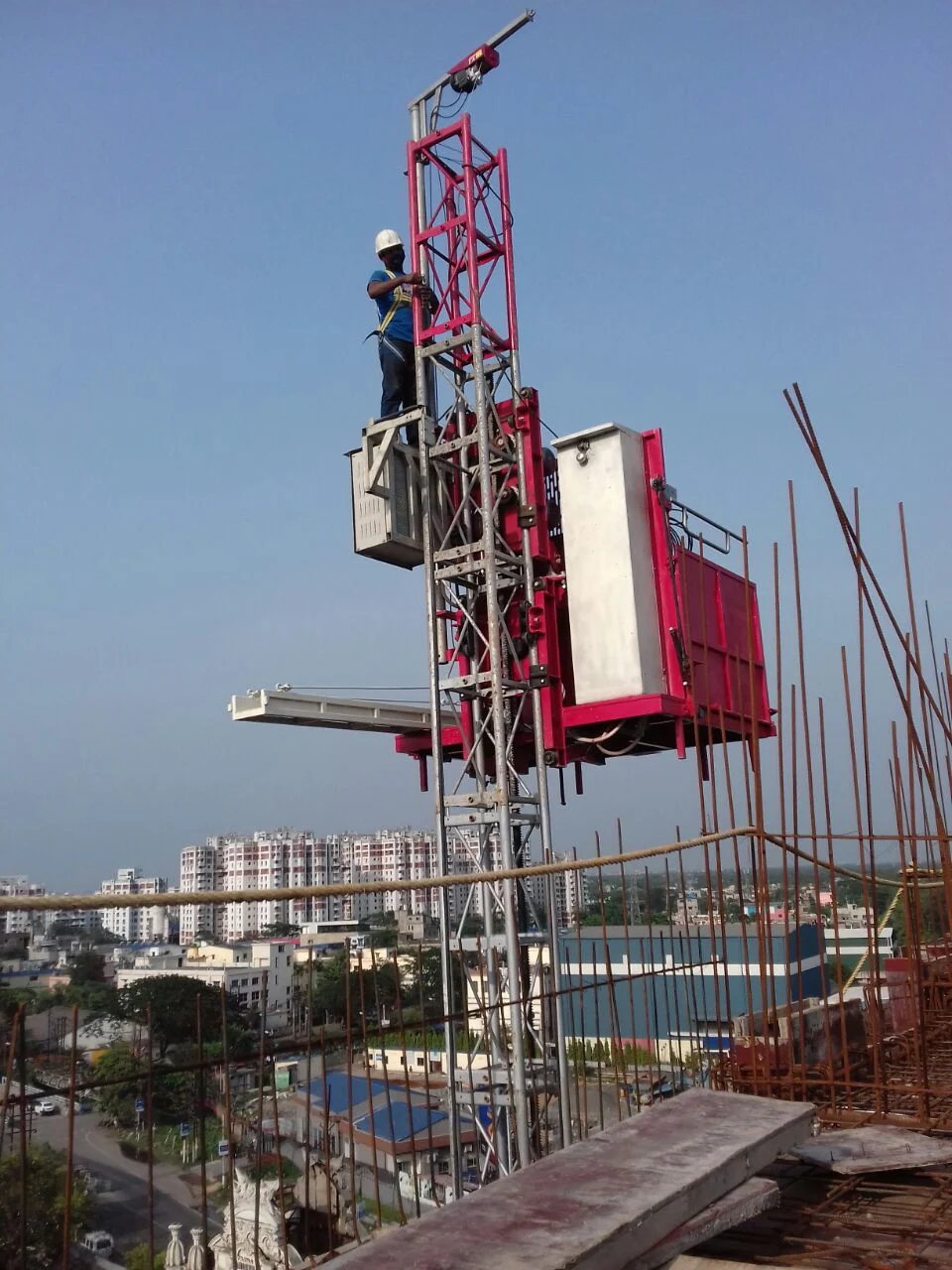
KEY COMPONENTS TABLE SECTION
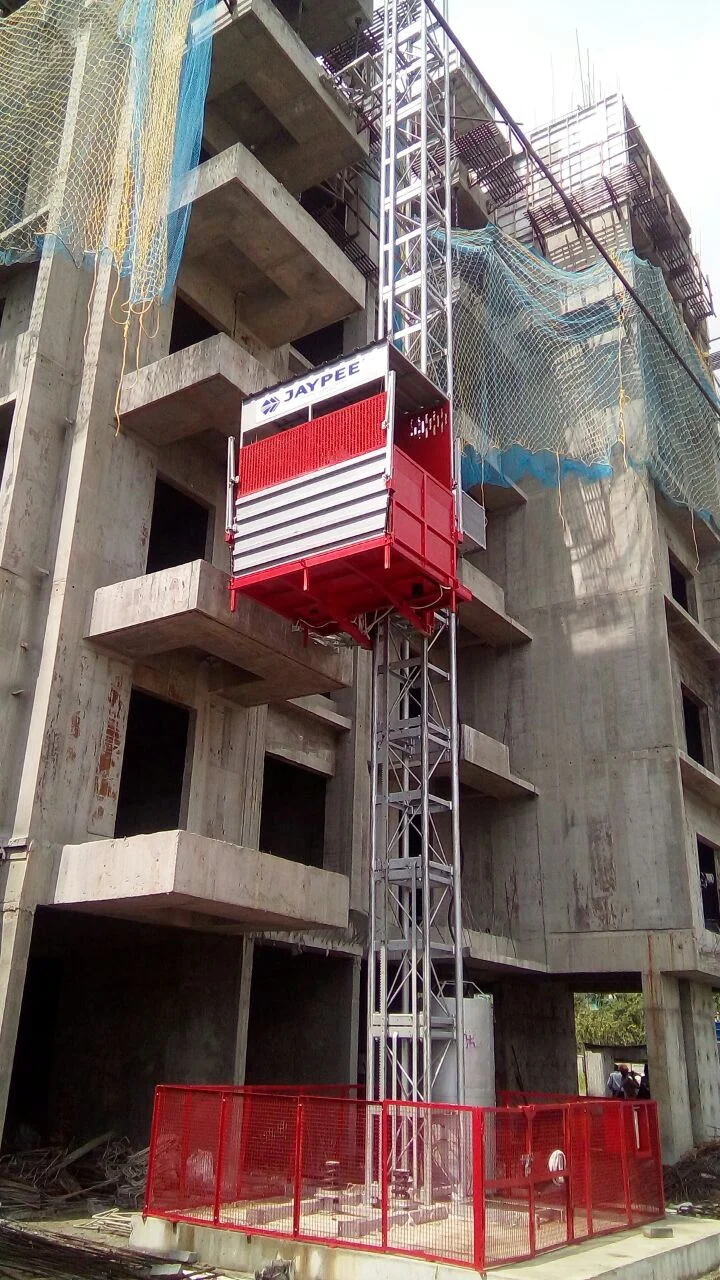
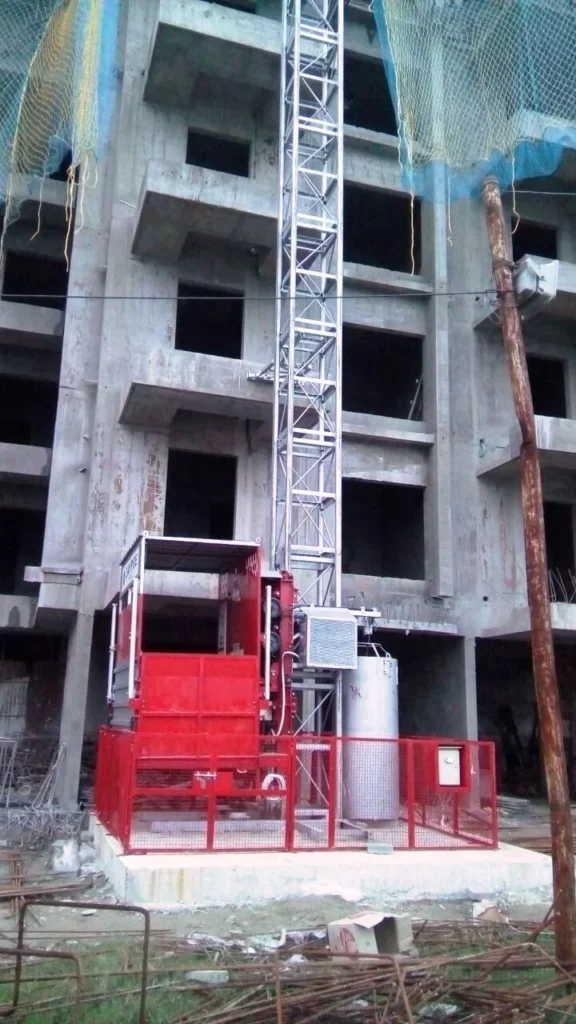
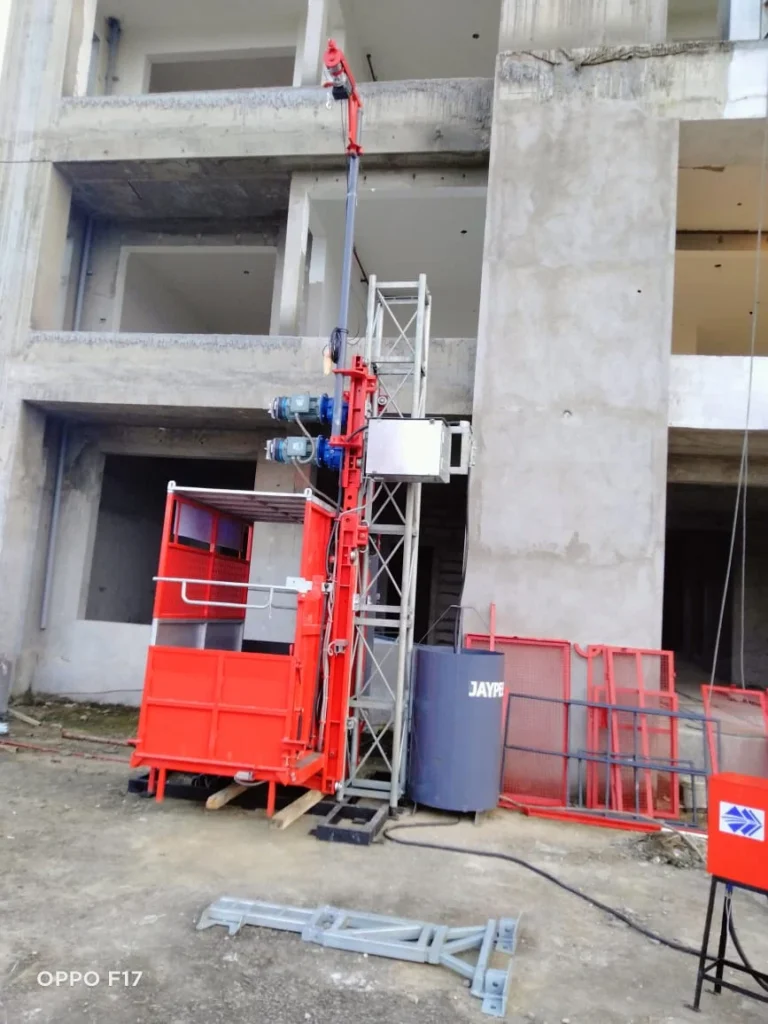
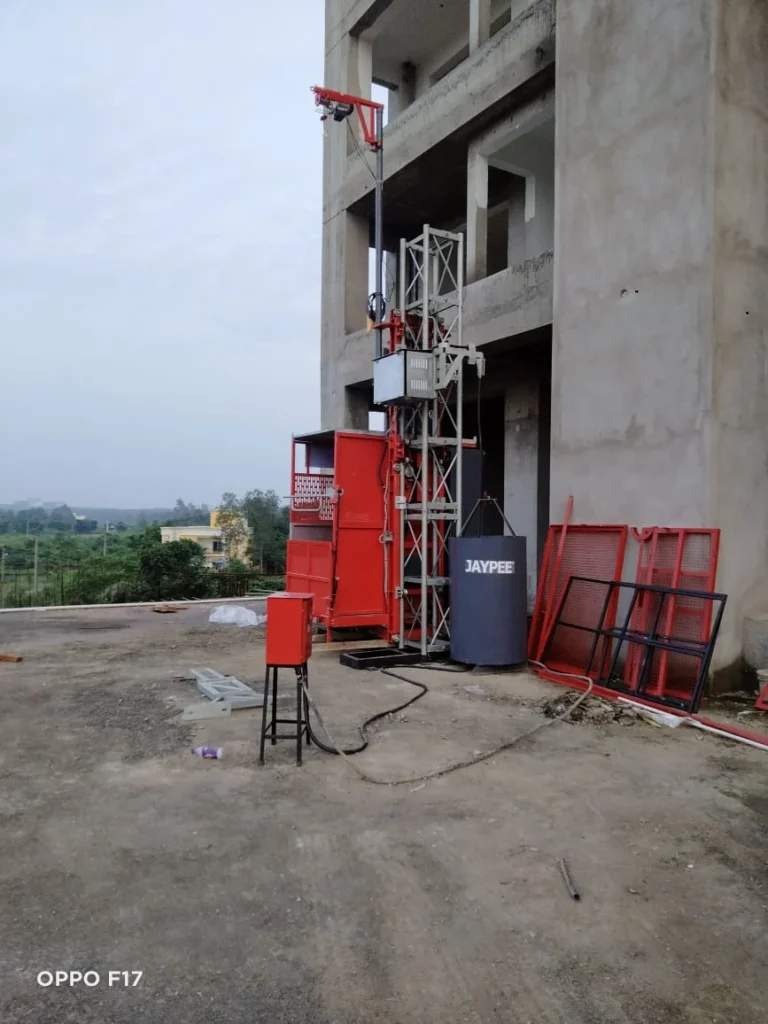
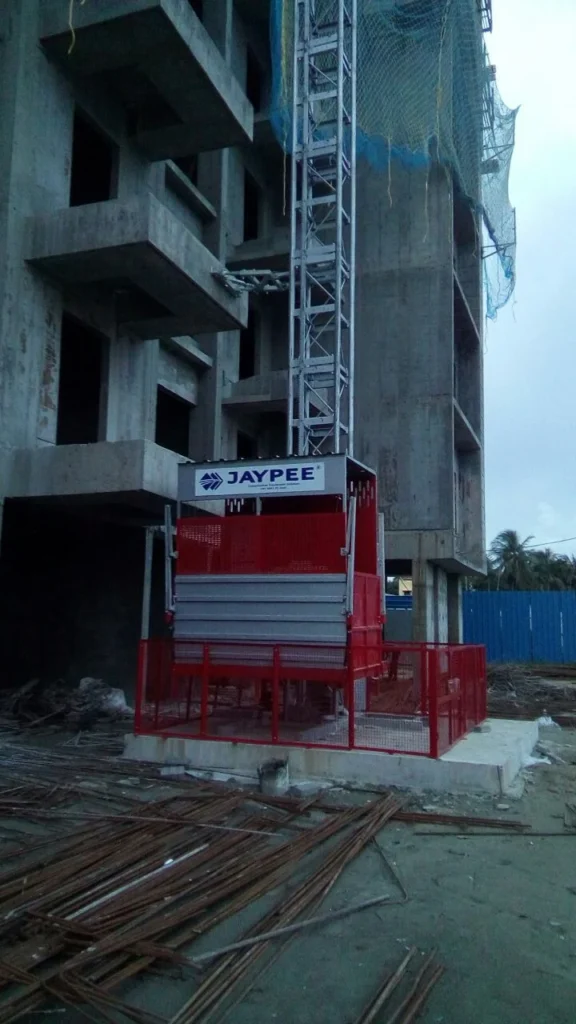
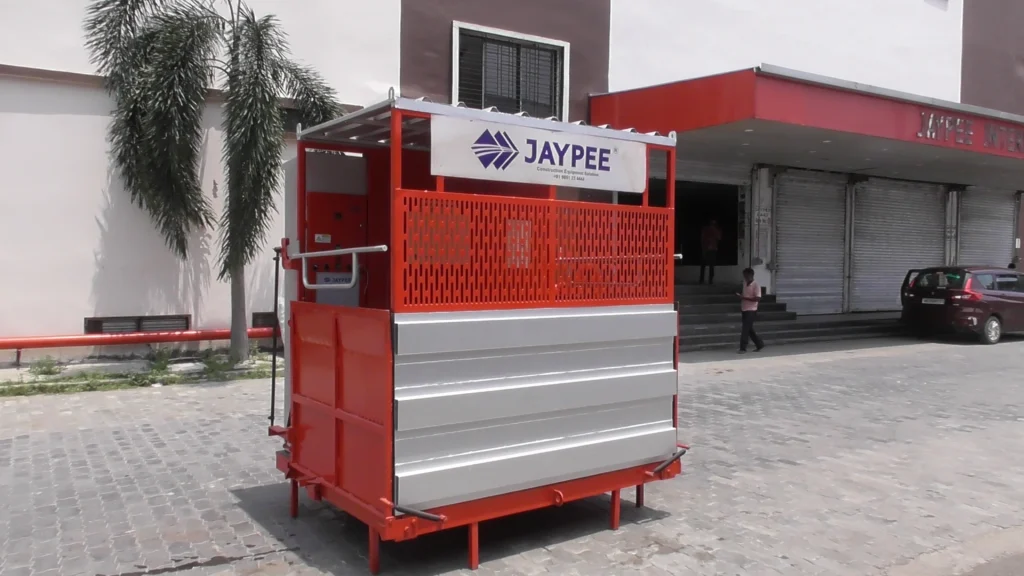
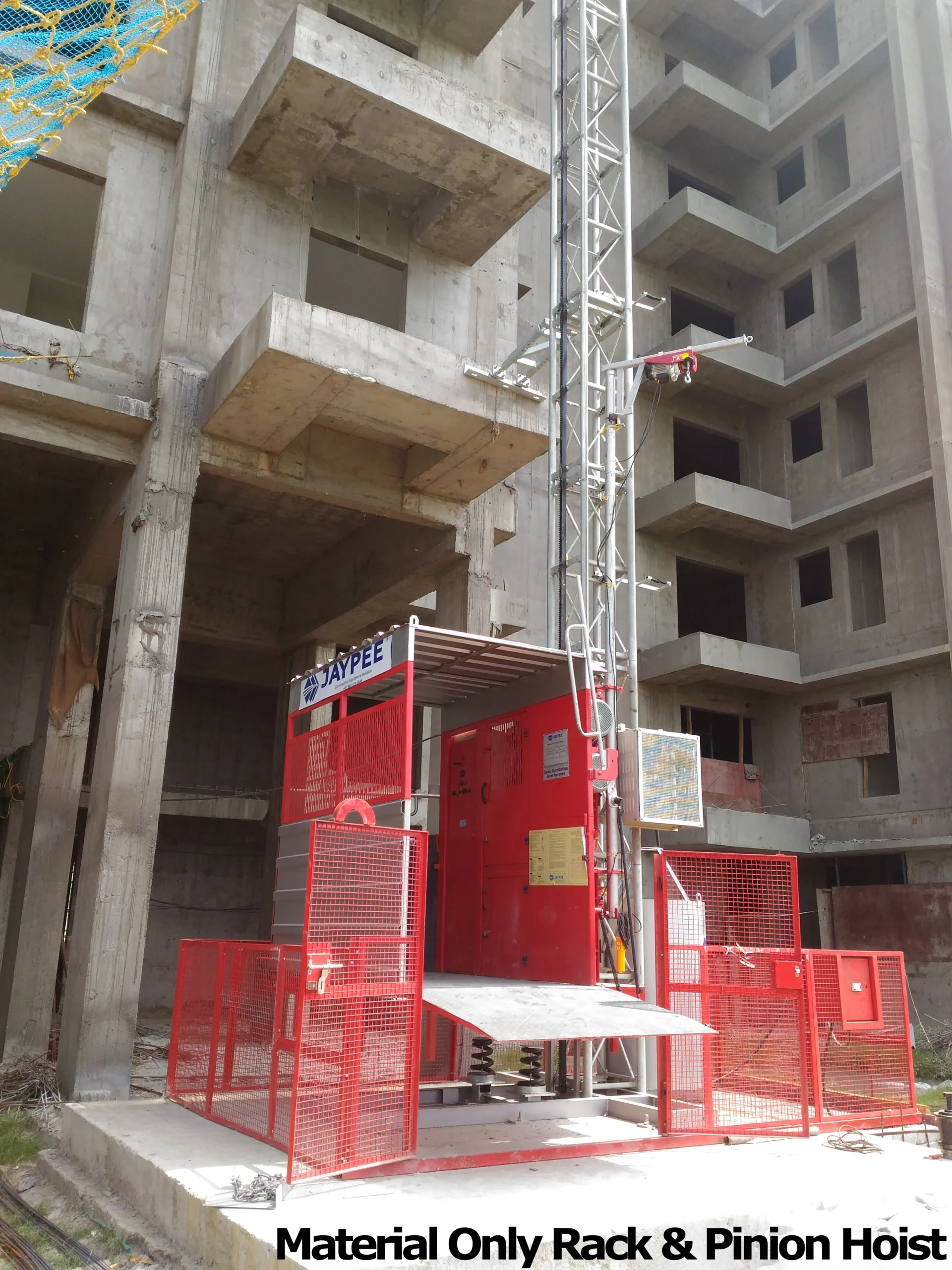
Key Components of a Jaypee® Material Hoist
| Component | Function |
|---|---|
| Mast Sections | Hot-dip galvanised modular steel tower — the vertical rail the platform climbs |
| Material Platform / Cage | Load-carrying surface — open for loose materials, enclosed for bagged goods |
| Rack and Pinion Drive | Motor-driven pinion climbs the toothed rack fixed to the mast |
| VFD Control Panel | Variable frequency drive for smooth speed control from 0 to 36 m/min |
| Anti-Fall Safety Device | Centrifugal governor — engages emergency braking if descent speed exceeds limit |
| PLC Controller | Programmable logic system monitoring all safety parameters in real time |
| Overload Limiter | Prevents operation if platform load exceeds rated capacity |
| Limit Switches | Upper and lower travel limits — automatic stop at maximum height |
| Wall Ties | Steel brackets anchoring the mast to the building frame at regular intervals |
| Electromagnetic Brake Motor | Holds platform position when stationary — prevents uncontrolled movement |
Variable Frequency Drive (VFD) Control
All JMH series material hoists feature VFD step-less speed control from 0 to 36 m/min. VFD eliminates load jerk on start and stop — critical when lifting fragile materials like glass panels, ceramic tiles, and prefabricated elements. It reduces mechanical wear across the drive system and extends the service life of the rack, pinion, and gearbox significantly.
PLC Safety Automation
A Programmable Logic Controller monitors every operational parameter continuously — overload detection, overspeed, door interlock, upper and lower limit switches, and floor position. When any parameter is breached, the PLC triggers an automatic safety shutdown before human intervention is possible. This prevents load drop accidents caused by operator error on busy construction sites.
Anti-Fall Centrifugal Safety Device
Every Jaypee® material hoist is equipped with a centrifugal anti-fall safety device. If the cage descent speed exceeds the rated limit due to rope or drive failure, the governor engages the mechanical emergency brake, stopping the loaded cage within a defined distance regardless of electrical power status. This is a non-negotiable safety requirement for any rack and pinion material hoist operating at height.
CE Certified and IS Compliant
All Jaypee® material hoist models carry full CE certification, meeting European Machinery Directive 2006/42/EC safety requirements. CE compliance requires third-party testing of the anti-fall device, overspeed governor, structural load performance, and all safety interlock systems. CE-certified material hoists are accepted by premium project consultants and government contractors across India and internationally.
Hot-Dip Galvanised Mast Sections
Mast sections are hot-dip galvanised rather than painted. Galvanisation penetrates the steel surface rather than coating it, providing corrosion resistance against monsoon rain, coastal humidity, and on-site chemical exposure that painted sections cannot match over an 18–24 month project duration.
Maximum Lifting Height — 450 Metres
Modular mast sections allow the material hoist to grow with the building. Additional sections are bolted on as construction progresses vertically — no need to replace the base unit. Jaypee® material hoists reach a maximum lifting height of 450 metres, covering India’s tallest infrastructure and high-rise projects.
Overload Limiter System
Jaypee® material hoists include electronic overload limiters that prevent the hoist from operating when the loaded cage exceeds the rated capacity. This protects the drive system, mast structure, and anti-fall device from the cumulative damage caused by repeated overloading — one of the most common causes of material hoist failure on Indian construction sites.
Stainless Steel Electrical Cabinets
All electrical enclosures are stainless steel with IP-rated protection. On outdoor construction sites, standard powder-coated cabinets corrode within months in monsoon conditions. Stainless steel enclosures maintain their protection rating throughout the project lifespan without degradation.
Self-Erecting Mechanism
Jaypee® JBH series builder hoists feature a self-erecting mechanism that allows installation without a separate crane or heavy lifting equipment. This reduces installation cost and time significantly on smaller sites where crane availability is limited.
Low Energy Consumption
Jaypee® material hoists use low-energy-consuming geared motors optimised for the duty cycle of construction material lifting. On sites where the hoist runs across two or three shifts daily for 18–24 months, energy efficiency directly impacts project operating costs.
Material Hoist vs Passenger Hoist — Key Differences
This is the most important distinction for project managers specifying vertical transport for a new construction project.
A material hoist is designed and certified exclusively for lifting construction materials. It does not have a passenger-certified enclosed cabin, and workers are strictly prohibited from riding in a material-only hoist under any circumstances. Material hoists are built for heavier loads, slower speeds, and continuous duty material handling cycles.
A passenger hoist is designed and certified specifically for carrying construction workers. It has an enclosed, reinforced cabin with anti-slip flooring, interior lighting, handrails, and safety systems tested to passenger-carrying standards. Workers can ride safely in a passenger hoist at all times.
A construction passenger and material hoist is a dual-rated unit certified for both workers and materials simultaneously, subject to combined weight limits.
| Feature | Material Hoist | Passenger Hoist |
|---|---|---|
| Workers allowed | No | Yes |
| Materials allowed | Yes | Yes (within capacity) |
| Max load capacity | Up to 8,000 kg | Up to 2,000 kg |
| Enclosed cabin | Optional | Always |
| Safety certification | CE goods standard | CE passenger standard |
| Speed | Up to 36 m/min | Up to 96 m/min |
| Best for | Heavy material lifting | Worker transport |
| Cost | Lower | Higher |
If your site requires worker transport in addition to material lifting, see our dedicated Passenger Hoist page or our Construction Passenger & Material Hoist range.
Applications of Material Hoists in Construction
Jaypee® material hoists are deployed across every segment of Indian and international construction:
High-Rise Residential Construction — Lifting concrete blocks, steel reinforcement, plumbing and electrical materials, interior finishing materials, and heavy tools across 20–60+ storey towers where manual carrying is impossible and crane time is too expensive.
Commercial Building Projects — Office towers, hotels, shopping malls, and mixed-use developments require continuous heavy material transport across multiple active floors during structural, MEP, and finishing phases.
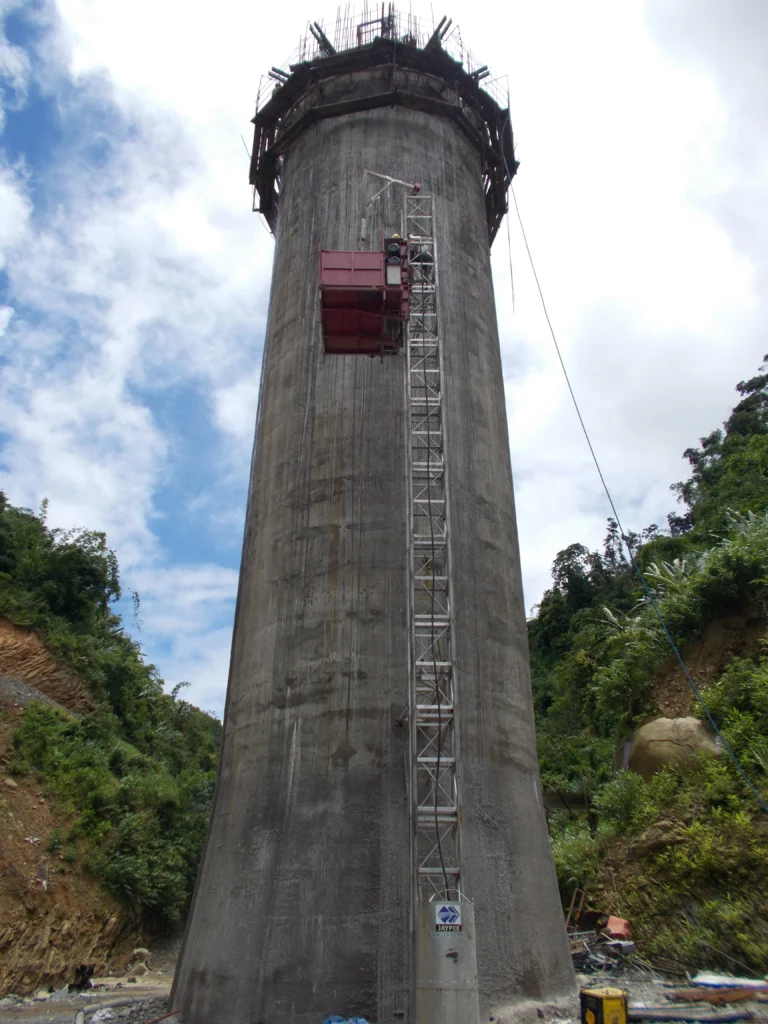
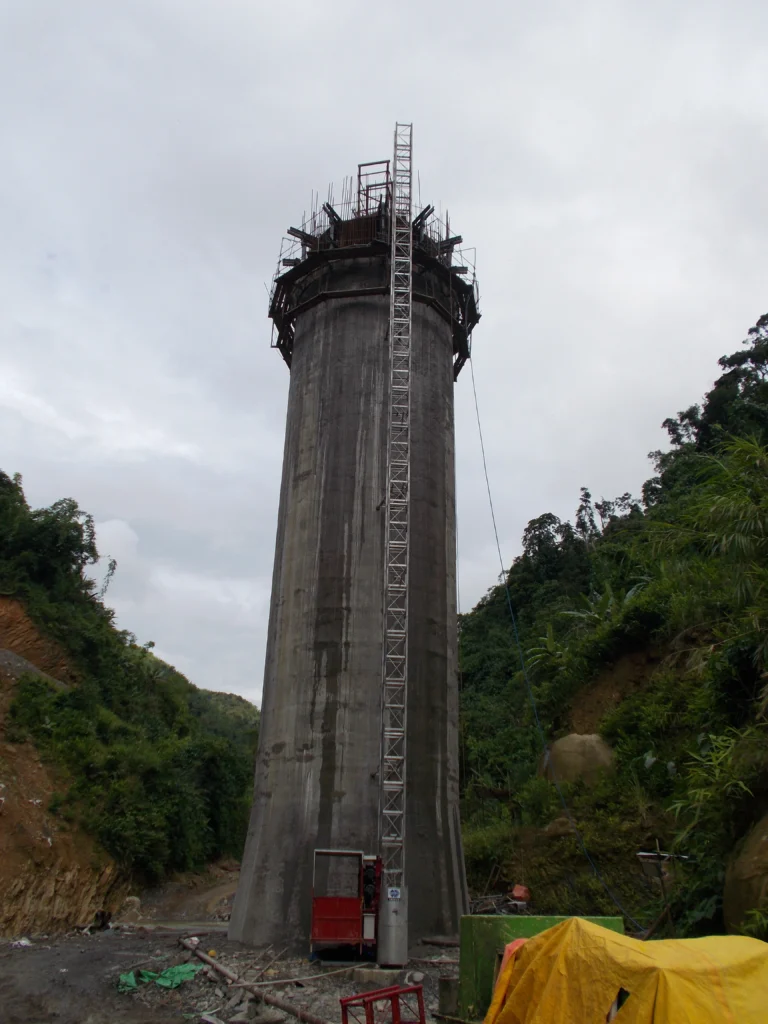
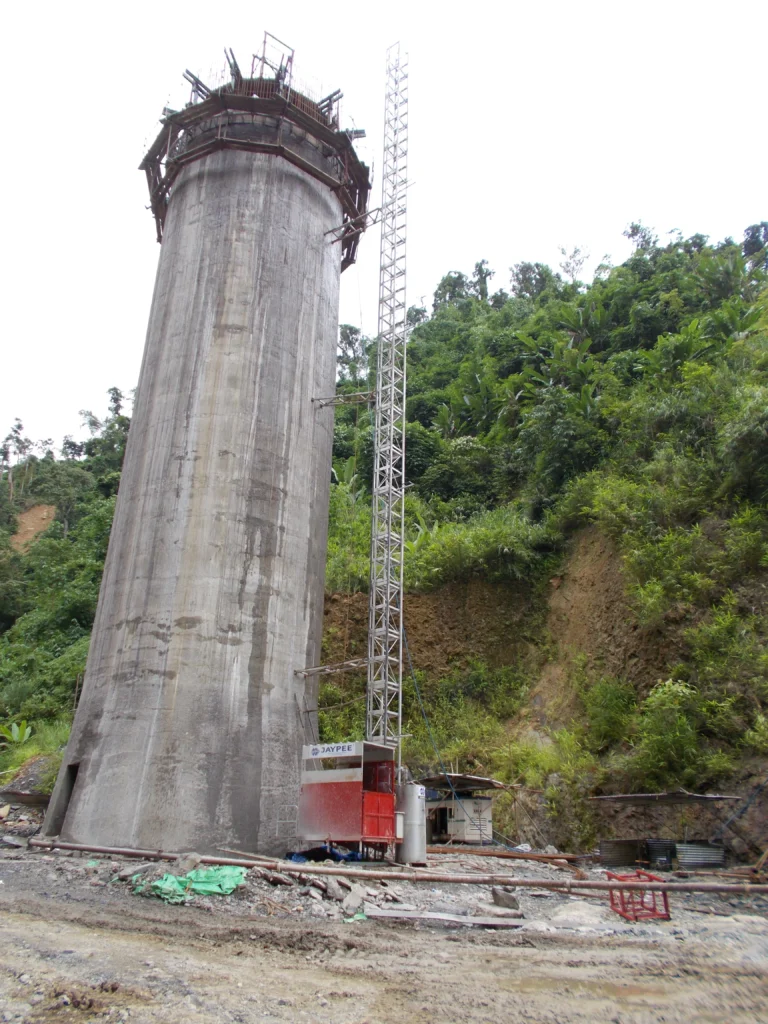
Infrastructure Development — Bridges, flyovers, metro rail viaducts, and large civil structures require lifting formwork, steel sections, and construction materials at heights where conventional crane access is restricted.
Industrial Plant Construction — Refineries, power plants, cement plants, and manufacturing facilities involve lifting heavy plant equipment, piping, and structural steel at elevation where material hoists provide the most cost-effective vertical access.
Renovation and Refurbishment — Large-scale renovation of existing buildings requires lifting demolition waste downward and new materials upward — a material hoist provides the safest, most efficient solution without damaging existing structure.
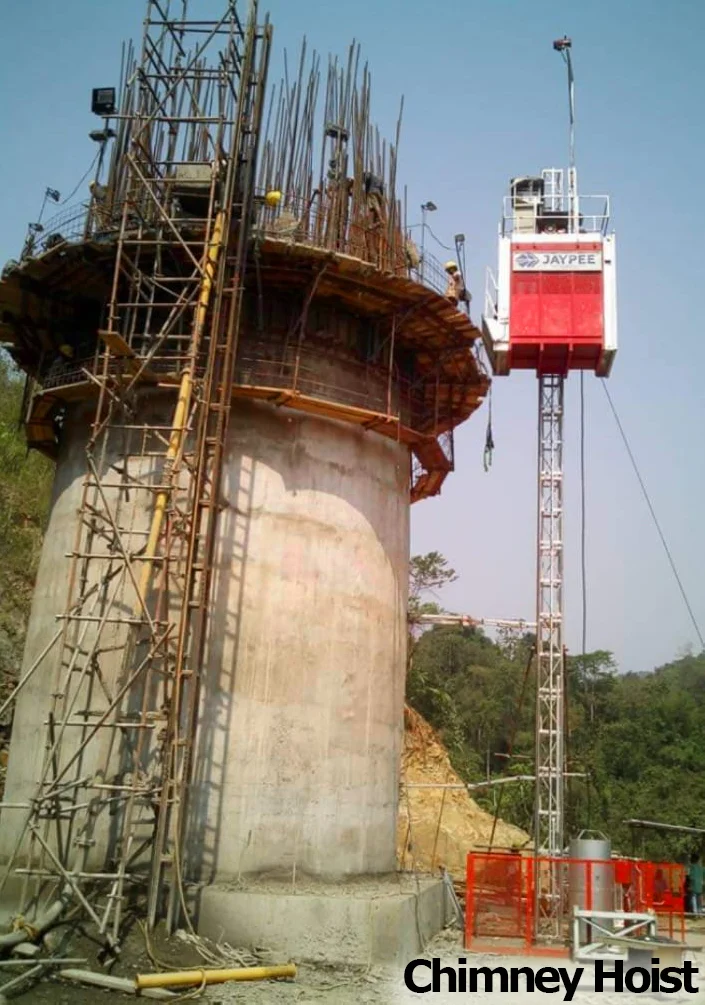
Bridge and Chimney Construction — Jaypee® manufactures a specialised Chimney Hoist for narrow vertical structures, with the JMH series covering general bridge and tower material lifting requirements.
Material Hoist Installation Process
A Jaypee® material hoist installation follows a structured process managed by trained Jaypee® engineers:
Site Survey and Foundation Design — Jaypee® engineers survey the site to determine base positioning, foundation load requirements, drainage, and mast anchor points. The base must be positioned on firm, level ground rated for the loaded hoist weight.
Base Frame and Initial Mast Erection — The base frame is levelled, anchored, and the initial mast sections are erected. Correct base levelling is critical — misalignment at the base multiplies at height.
Platform and Drive Unit Assembly — The material platform or cage, motor, gearbox, and rack-and-pinion drive unit are assembled and connected. The VFD control panel is commissioned and all safety devices are tested.
Wall Tie Installation — Mast wall ties are installed at regular intervals — typically every 6 metres — as the mast rises. Ties must be anchored to the structural frame only.
Progressive Mast Climbing — As construction proceeds floor by floor, additional mast sections are bolted on from the top of the existing mast. A trained rigger adds sections progressively — typically one to two sections per day.
Pre-Commissioning Load Test — Before first use, Jaypee® engineers conduct a full pre-commissioning test: load test at 110% rated capacity, anti-fall device test, overspeed governor test, limit switch tests, and overload limiter calibration.
Why Contractors Across India Choose Jaypee® Material Hoists
Manufacturer-Direct Supply — Jaypee® India Limited manufactures every hoist component. When you buy directly from Jaypee®, you receive manufacturer pricing, direct technical support, and engineering customisation that distributors cannot provide.
42 Years of Manufacturing Experience — Jaypee® has been manufacturing construction hoisting equipment for over four decades, with hundreds of material hoist installations across India’s residential, commercial, and infrastructure sectors.
Pan-India Service Network — Fast-response Jaypee® service teams and genuine spare parts are available across all major Indian cities including Kolkata, Delhi, Mumbai, Chennai, Hyderabad, and Bengaluru. Material hoist downtime is a project emergency — Jaypee’s network resolves issues in hours, not days.
ISO-Compliant, CE-Certified Manufacturing — Every Jaypee® material hoist is manufactured under ISO-compliant processes, tested before dispatch, and CE certified. This is the standard required by premium project consultants and government-tendered contracts.
Full After-Sales AMC Support — Jaypee® offers Annual Maintenance Contracts covering all scheduled preventive maintenance, emergency response, and genuine parts availability for the full project duration.
Material Hoist Safety Standards
Jaypee® material hoists comply with the following safety standards:
CE Certification — European conformity marking confirming compliance with EU Machinery Directive 2006/42/EC.
IS 7521 (Bureau of Indian Standards) — Indian standard for construction hoists covering design, manufacture, installation, inspection, and maintenance.
ISO 16368 — International standard for construction hoists specifying safety requirements for design, calculations, stability, construction, examination, and testing.
Anti-Fall Safety Device — Every Jaypee® material hoist carries a centrifugal anti-fall governor tested and certified to stop the loaded cage within a defined distance in the event of drive failure.
Material Hoist Safety Standards and Certification in India (2026)
Every Jaypee® material hoist complies with the following mandatory standards:
IS 7521 — Bureau of Indian Standards Indian standard covering the design, manufacture, installation, inspection, and maintenance of construction hoists. Factory Inspectorate registration under IS 7521 is required in most Indian states before a hoist can be commissioned on site.
CE Certification — EU Machinery Directive 2006/42/EC European conformity marking requiring third-party testing of the anti-fall device, overspeed governor, structural load performance, and all safety interlock systems. CE certification is the mandatory standard for all government-tendered projects and premium private construction contracts in India.
ISO 16368 International standard specifying safety requirements for the design, calculations, stability, construction, examination, and testing of construction hoists.
Annual Safety Device Recertification The anti-fall centrifugal governor must be independently tested and recertified every 12 months. A material hoist operating with an expired safety device certificate must be immediately taken out of service — the safety device is the only mechanism preventing free-fall in the event of drive failure.
PRICE SECTION
H2: Material Hoist Price in India 2026
| Model | Capacity | Approximate Price Range |
|---|---|---|
| JBH 100 (Builder Hoist) | 1,000 kg | ₹6,00,000 – ₹10,00,000 |
| JBH 200 (Builder Hoist) | 2,000 kg | ₹10,00,000 – ₹15,00,000 |
| JMH 100 (Rack & Pinion) | 1,000 kg | ₹8,00,000 – ₹14,00,000 |
| JMH 200 (Rack & Pinion) | 2,000 kg | ₹14,00,000 – ₹22,00,000 |
| JMH 300 (Rack & Pinion) | 3,000 kg | ₹22,00,000 – ₹35,00,000 |
| JMH 500 (Rack & Pinion) | 5,000 kg | ₹35,00,000 – ₹48,00,000 |
| JMH 800 (Rack & Pinion) | 8,000 kg | ₹48,00,000 – ₹70,00,000 |
Prices are indicative and vary based on maximum lifting height, site configuration, optional attachments, and delivery location. Contact Jaypee® for a site-specific quotation.
Frequently Asked Questions — Material Hoist
Frequently Asked Questions — Material Hoist
Q1: What is a material hoist and what is it used for? A material hoist is a temporary rack and pinion vertical lifting system installed on construction sites to carry building materials — concrete, steel, bricks, tiles, equipment — between ground level and upper floors. It is certified for goods only; workers are prohibited from riding in a material hoist. After project completion, the hoist is dismantled and reused on the next site.
Q2: What is the difference between a material hoist and a passenger hoist? A material hoist is designed and certified exclusively for lifting construction materials — it does not carry workers. A passenger hoist is designed and certified to carry construction workers safely, with an enclosed reinforced cabin, interior lighting, anti-slip flooring, and higher-standard safety systems. Never allow workers to ride a material-only hoist — even if it looks identical to a passenger hoist, the safety certification and structural testing are fundamentally different.
Q3: What is a rack and pinion material hoist? A rack and pinion material hoist uses a toothed steel rack fixed to the mast and a motor-driven pinion gear on the platform to climb vertically. This mechanism is inherently safe — free-fall is mechanically impossible because the rack and pinion holds the platform in position even if electrical power fails. Jaypee’s JMH series uses rack and pinion drive across all models from 1,000 kg to 8,000 kg.
Q4: What is the maximum height a material hoist can reach? Jaypee® rack and pinion material hoists reach a maximum lifting height of 450 metres using modular bolted mast sections added progressively as the building rises. For buildings under 8–10 floors, the JBH builder hoist series covering up to 125 metres is a more cost-effective choice.
Q5: Can workers ride in a material hoist? No. A material-only hoist must never carry workers under any circumstances. If your project requires vertical worker transport in addition to material lifting, Jaypee® manufactures dedicated Passenger Hoists and combined Construction Passenger & Material Hoists.
Q6: What safety certifications must a material hoist have in India? CE certification and/or IS 7521 compliance from the Bureau of Indian Standards is the minimum requirement. The anti-fall centrifugal governor must hold a current test certificate — within the last 12 months. Factory Inspectorate registration is required in many Indian states before first commissioning on site.
Q7: What is the difference between a material hoist and a builder’s hoist? A rack and pinion material hoist (JMH series) uses a motorised pinion on a toothed mast rack for precise, high-capacity lifting on mid to high-rise projects — up to 8,000 kg and 450 metres. A builder’s hoist or tower hoist (JBH series) is a simpler, lower-cost cable and pulley system on a lightweight mast, suited for low-rise residential sites up to 8 floors and 500–2,000 kg loads.
Q8: How much does a material hoist cost in India? Jaypee® material hoist pricing depends on model (JMH 100 to JMH 800 or JBH series), load capacity, lifting height, and site requirements. Indicative prices range from ₹6 lakh for a basic builder hoist to ₹70 lakh for a heavy-duty 8,000 kg JMH 800 unit. Jaypee® provides manufacturer-direct pricing with no distributor markups. Contact us for a site-specific quotation.
Q9: What routine maintenance does a material hoist need? Daily visual inspection of platform, mast, rack, and safety devices. Weekly lubrication of rack, pinion, and guide rollers. Monthly electrical panel and gearbox inspection. Annual full structural inspection and anti-fall device recertification by an independent certifying authority. Jaypee® offers Annual Maintenance Contracts covering all scheduled preventive maintenance.
Q10: What is an MFH hoist? MFH stands for Multi-Function Hoist — a Jaypee® JMH series material hoist fitted with interchangeable platform attachments. The rebar carrier handles steel bars up to 6 metres horizontally, the concrete bucket handles ready-mix concrete up to 0.4 cu/m, and the flat platform handles all general construction materials. The MFH configuration is the highest-productivity material hoist setup for Indian high-rise construction sites.
Related Jaypee® Products
- Passenger Hoist — CE certified worker transport, 700–2000 kg, up to 450m
- Construction Passenger & Material Hoist — Dual rated for workers and heavy materials simultaneously
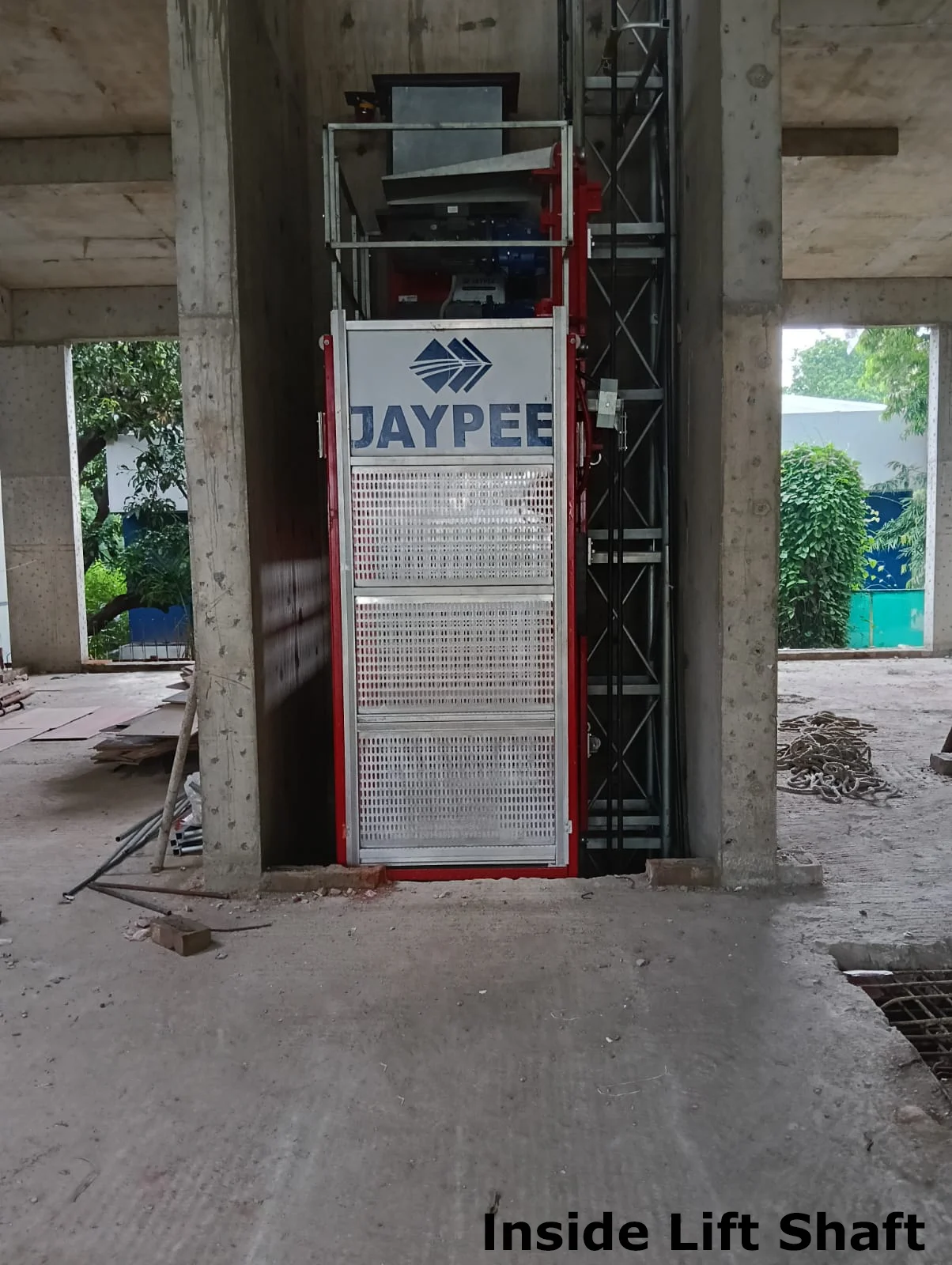
- Inside Lift Shaft Hoist — For permanent shaft and interior vertical access installations
- Chimney Hoist — Purpose-built for narrow chimney and tower structures
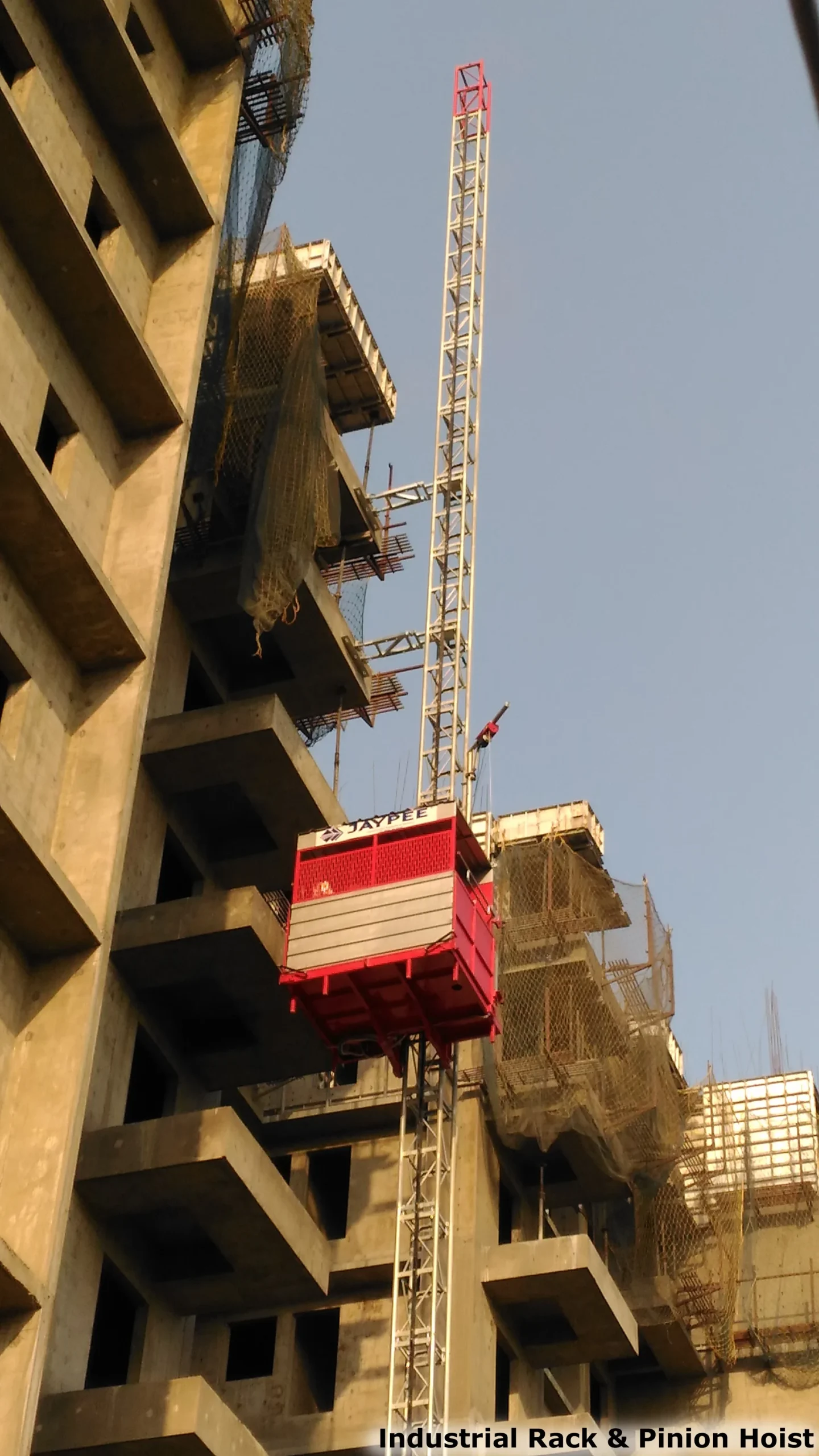
- Industrial Rack & Pinion Elevators — For permanent industrial plant vertical access
Get a Free Consultation for Your Material Hoist Project
Jaypee® engineers provide free site consultations for all material hoist projects. Whether you need guidance on model selection, load capacity, installation planning, or a competitive quotation, our team responds within 24 hours.
Jaypee materials hoist along with multiple features and safety kits, these material hoists … Rajendra Prasad Sarani (Clive Row), Kolkata 700 001, India. Delhi
Contact Jaypee® India Limited:
- WhatsApp / Call: +91 96745 15151
- 24×7 Hotline: +91 90512 34444
- Email: solutions@jaypee.in
- Head Office: 11, Dr. Rajendra Prasad Sarani (Clive Row), Kolkata 700 001
- Delhi: 1111, Hemkunt Chambers, 89 Nehru Place, New Delhi 110019
- Mumbai: Jaypee House, CBD Belapur 400614
Request Free Consultation on WhatsApp → Download Jaypee® Material Hoist Brochure 2025